
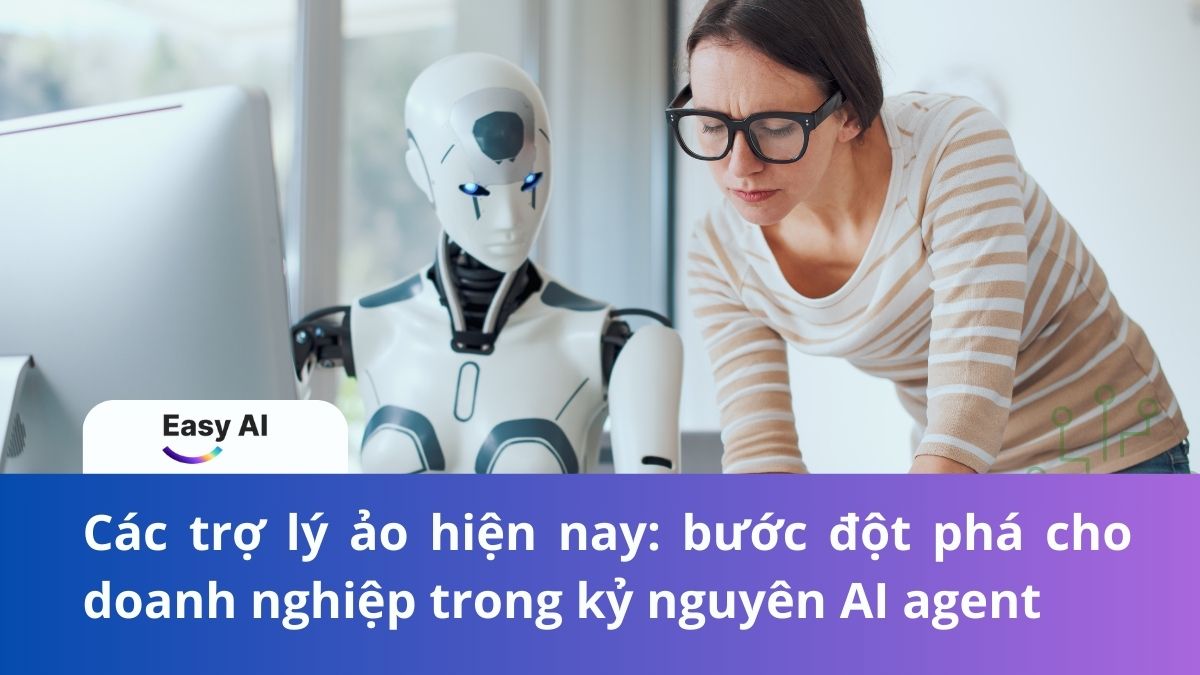
This article takes a deep dive into the fundamentals of AI agents, their roles, advantages, challenges, and the opportunities they create for businesses, while also highlighting leading players in the space.
What is an AI Agent?
To fully understand the power of modern virtual assistants, we first need to clarify the concept of an AI agent. In the field of artificial intelligence, an AI agent is defined as an intelligent entity capable of perceiving its environment, making decisions, and taking actions to achieve specific goals. Unlike traditional computer programs that operate based on fixed instructions, AI agents can learn, adapt, and solve problems flexibly.

You can think of an AI agent as a “virtual employee” capable of handling a wide range of tasks, from simple ones like answering FAQs and scheduling appointments to more complex work such as analyzing data, delivering strategic recommendations, or even automating parts of decision making in certain scenarios. The biggest difference between an AI agent and a traditional chatbot is autonomy and proactivity. While chatbots typically respond based on predefined scripts, AI agents can actively search for information, assess the situation, and take appropriate actions without requiring direct human involvement at every step.
Advantages and Roles of Modern Virtual Assistants
Modern virtual assistants deliver significant business value, including:
Optimize performance and productivity:
With 24/7 availability, virtual assistants free people from repetitive, time consuming tasks. Employees can focus on strategic work that requires creativity and complex thinking. This leads to a meaningful lift in overall productivity and operational efficiency.
Improve customer experience:
Virtual assistants can provide fast customer support anytime, anywhere. Instant responses, clear guidance, and quick problem resolution help increase customer satisfaction and loyalty.
Reduce operating costs:
Compared with hiring additional staff, deploying virtual assistants can significantly reduce costs, especially in functions like customer support, administration, and HR.
Personalize interactions:
By analyzing data and learning from conversations, virtual assistants can deliver personalized experiences for each customer from recommending relevant products and tailored offers to adjusting tone and messaging to build stronger relationships.
Enable data driven decision making:
AI agents can collect, analyze, and process large volumes of data quickly and accurately. These insights can support smarter business decisions, from forecasting market trends and optimizing marketing campaigns to improving risk management.
Challenges in Adopting Virtual Assistants
Alongside the benefits, adopting modern virtual assistants also presents several challenges:
Implementation complexity and cost:
Developing and deploying AI agents, especially advanced systems, requires significant investment in budget, talent, and technology. Integrating virtual assistants into existing enterprise systems can also be technically demanding.

Ability to handle out of script scenarios
Although AI agents are becoming increasingly capable, they can still struggle with unexpected situations outside their training scope. This may lead to a poor user experience if human intervention is not available in time.
Security and privacy concerns
Modern virtual assistants often collect and process large volumes of user data, including sensitive personal information. As a result, data security and privacy become major concerns, requiring businesses to implement strict protection measures.
Skills and training requirements
To fully leverage virtual assistants, employees need training on how to interact with, manage, and monitor them. At the same time, businesses must build a capable expert team to develop, maintain, and continuously improve the AI agent system.
Legal and ethical barriers
As AI agents become more powerful and autonomous, legal and ethical questions inevitably arise. For example, who is responsible if a virtual assistant makes a wrong decision that causes negative consequences? How can we ensure AI agents operate fairly, without bias, and without violating societal ethical standards?
>>> Read more: What Is Generative AI? Why Easy AI Chat Is Leading AI Integration for Businesses?
Opportunities for Businesses Adopting Virtual Assistants
Despite these challenges, the potential value of modern virtual assistants is significant. In the near future, businesses can expect opportunities such as:
- Stronger competitiveness: Early adopters of AI agents can gain a major edge over competitors. Automation, cost optimization, improved customer experience, and data driven decision making enable faster adaptation and market share growth.
- Business scalability: Virtual assistants help businesses scale quickly and efficiently. The ability to serve large numbers of customers simultaneously, operate 24/7, and automate many tasks reduces resource constraints and allows teams to focus on entering new markets.
- New products and services: AI agent technology does not only improve existing operations it also enables entirely new offerings. For example, virtual assistants can be embedded into products to add smart features, personalize user experiences, or deliver specialized AI based advisory and support services.
- Accelerated digital transformation: Deploying virtual assistants is a key step in digital transformation. It is not only about adopting new technology, but also about shifting mindset, processes, and workplace culture. Businesses that successfully implement AI agents build a strong foundation for continuous innovation and growth in the digital era.
>>> Read more: Dien may XANH integrates an AI sales chatbot effectively on its website
Top Leading AI Virtual Assistant Brands and Companies Worldwide

The market for modern virtual assistants is growing rapidly, with many of the world’s leading technology companies participating. Below are some notable names:
- Google Assistant: A virtual assistant developed by Google, deeply integrated into the Android ecosystem, Google Home smart devices, and many other platforms. Google Assistant is known for its natural language processing capabilities, information search, and smart device control.
- Amazon Alexa: Amazon’s virtual assistant, widely used on Echo devices and Fire TV. Alexa focuses on voice control, online shopping, and tight integration with Amazon services.
- Apple Siri: The default virtual assistant on Apple devices, from iPhone and iPad to Mac. Siri is recognized for natural interaction, support for basic tasks, and seamless integration across the Apple ecosystem.
- Microsoft Cortana: Microsoft’s virtual assistant, integrated into Windows 10, Microsoft 365, and Xbox. Cortana focuses on work support, schedule management, and personalized information.
- IBM Watson Assistant: IBM’s enterprise grade virtual assistant platform, known for strong customization, security, and integration with enterprise systems. Watson Assistant is widely used in areas such as customer service, finance, and healthcare.
- Nuance Conversational AI: A company specializing in speech recognition and natural language technologies, providing virtual assistant solutions across industries, especially healthcare and finance.
- Salesforce Einstein: An AI platform integrated into Salesforce CRM, delivering intelligent virtual assistant capabilities for sales and customer service teams.
In addition, many other companies and startups are developing modern virtual assistants with unique features and use cases, promising to reshape how we interact with technology in the future.
Modern virtual assistants powered by AI agents are opening a new chapter for businesses in the digital era. While challenges remain, their potential and opportunities are undeniable. Businesses that embrace this trend and successfully embed virtual assistants into operations will gain a significant edge in the competitive race, improve efficiency, and create superior customer value.
Want to explore the power of modern virtual assistants for your business? Contact Easy AI Chat today to get expert consultation and experience advanced AI agent solutions. https://geteasy.ai/