
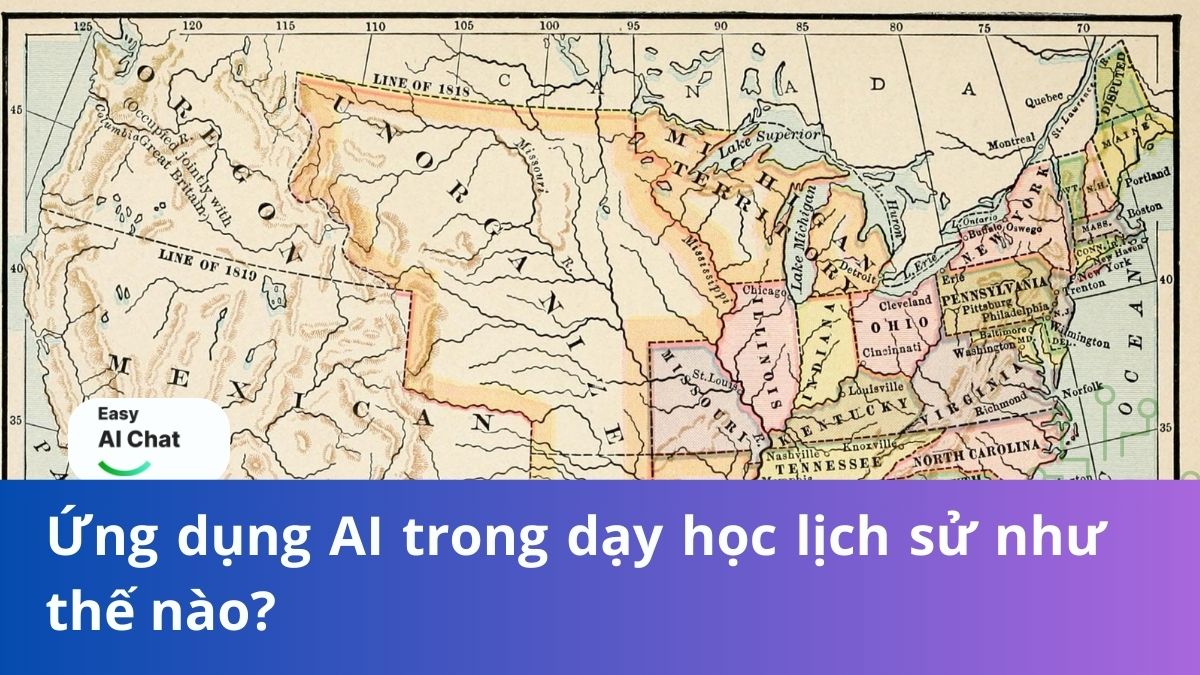
AI can personalize learning pathways for each student by analyzing learning outcomes and recommending appropriate content. In addition, AI is capable of recreating historical events through 3D visuals, simulation videos, and interactive models, allowing students to “experience” history rather than simply read about it.
Beyond supporting students, AI also helps teachers optimize teaching methods. Teachers can use AI to create engaging lessons tailored to individual student levels, making instruction more effective.
Enhancing interaction and knowledge retention
AI can generate intelligent assessments, learning games, and instructional chatbots. This enables students to absorb knowledge in a more natural and effective way. AI teaching assistants also help educators track learning progress and analyze data to optimize instructional strategies.
Moreover, AI can be integrated with augmented and virtual reality (AR/VR) technologies, allowing students to “travel through time,” experience historical battles, or interact with historical figures via virtual models. This represents a major step forward in making history education more engaging.

These tools help students become more engaged with history, rather than merely memorizing dry theoretical content. Through the application of AI in history education, knowledge acquisition becomes more vivid and easier to retain.
AI supports more effective and less monotonous teaching
AI can collect student data, analyze learning habits, and provide appropriate recommendations, enabling teachers to easily monitor each student’s learning progress. In addition, AI chatbots can function as virtual teaching assistants, answering questions and supporting students in review and revision.

AI also helps develop history learning games in which students take on the roles of historical figures and participate in major historical events. This allows students not only to learn about history but to “live” it.
In addition, AI can support the creation of flexible lesson plans, helping teachers save time on lesson preparation. Through the application of AI in history education, lessons can be designed to suit different student groups, optimizing knowledge absorption.
>>> See more: The Infinite Potential and Risks of AI: A Comprehensive Perspective for 2025
Data analysis and personalized learning
One of the key strengths of applying AI in history education is its ability to analyze learning data. AI helps teachers identify students’ weaknesses, recommend appropriate teaching methods, and personalize learning content.
Furthermore, AI can automatically generate learning materials from multiple reliable sources, compile historical resources, create assessments tailored to different levels, or provide practice exercises to help students reinforce their knowledge.

AI analyzes data and personalizes learning
AI also supports the creation of individualized learning pathways for each student based on previous learning outcomes. This enables students to learn at their own pace without falling behind their peers.
With strong data analysis capabilities, the application of AI in history education also helps teachers evaluate teaching quality and improve instructional methods to achieve the best outcomes.
The application of AI in history education not only helps students access knowledge more effectively but also transforms teaching methods, creating innovative learning experiences. AI enables personalized content, vivid simulations of historical events, and optimized teaching support for educators.
It is undeniable that AI is ushering in a new era in education, offering students more effective learning opportunities. As technology advances, the application of AI in history education will become increasingly widespread, delivering even greater benefits to both students and teachers.
Educational institutions and individuals interested in applying AI to teaching can explore advanced technology solutions from Easy AI to stay ahead of the trend. To learn more, contact Easy AI today for detailed consultation.